


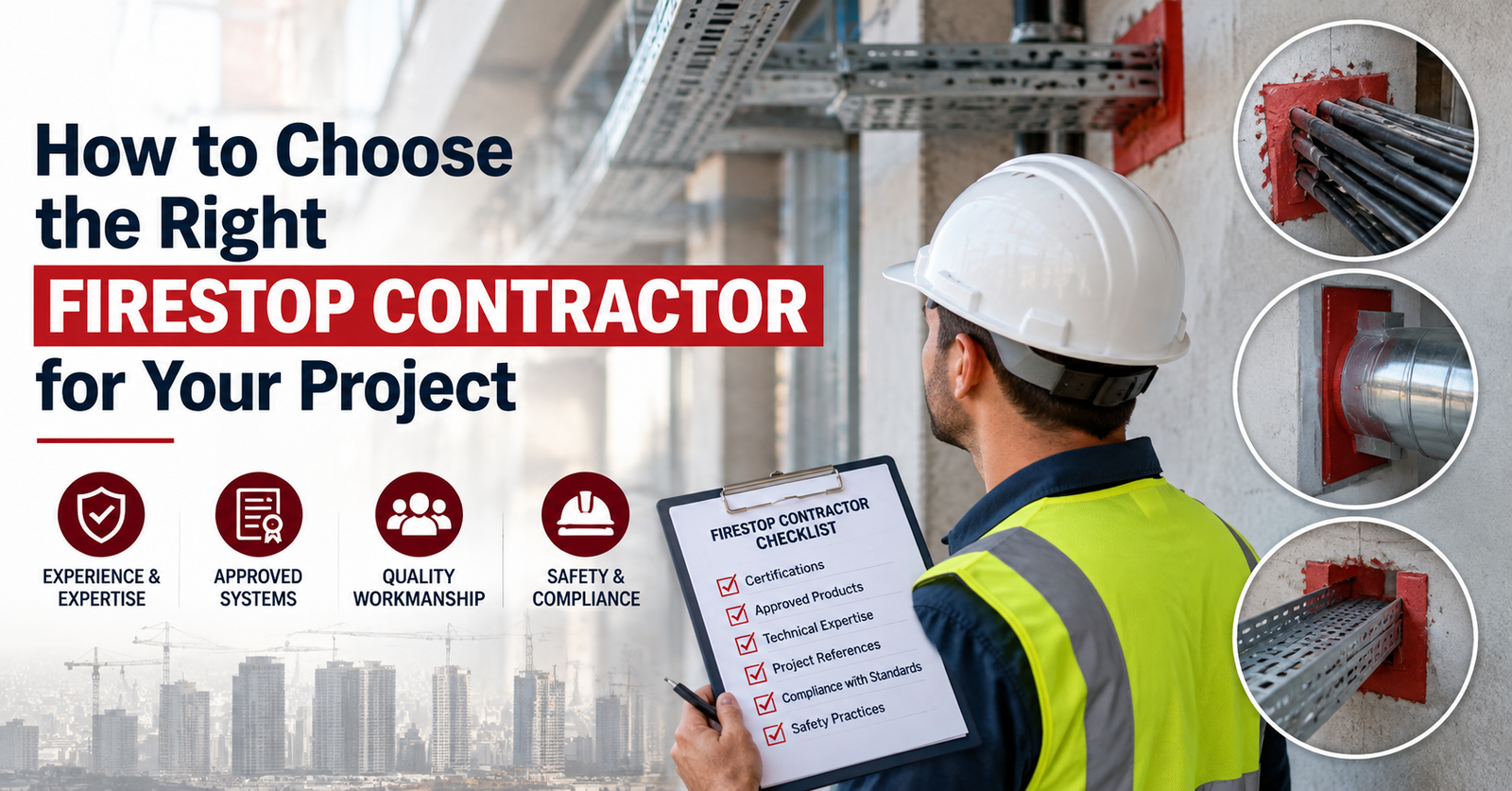
 passive fire protection Qatar Saudi Arabia
A firestop scope looks small on a bill of quantities. A few line items for penetration seals, some joint sealing, a handful of fire-rated closures. Then the civil defence inspection comes around, the inspector asks for the system reference behind a sealed cable tray, and nobody on site can produce it. The handover stalls, the MEP contractor blames the firestop subcontractor, and the main contractor absorbs the delay.
This is the most common way passive fire protection in Qatar and Saudi Arabia goes wrong — not because the material failed, but because the contractor was chosen on price alone. This guide covers what to check before you award the work.
Why the Contractor Matters More Than the Product
Firestop materials are only rated when installed as part of a tested system: a specific sealant or mortar, in a specific opening, around a specific penetrant, in a wall or floor of a specific construction. Change any one of those and the rating no longer applies.
That means the installer’s judgement is the product. A firestop contractor who understands which system fits which condition, and who records it, is what actually delivers fire compartmentation on site. One who simply fills holes with “fire-rated” sealant is delivering a liability.
What Should You Check Before Awarding Firestop Work?
Ask every bidder for the following. The answers will separate serious firestop services in Qatar from general trades who add firestopping to their scope when it is convenient.
1. Can they match each condition to a tested system?
Give them three or four real penetration details from your drawings — a cable bundle through a block wall, a PVC pipe through a slab, a duct through a drywall partition. A capable contractor will name a tested system for each, or tell you honestly where an engineering judgement is needed.
2. What documentation do they hand over?
At minimum you should receive a schedule listing every sealed opening, the system used, the rating achieved, the installer, and the date. Photographs before and after sealing are standard practice. Without this, your civil defence inspection becomes an argument rather than a review.
3. Who is actually on the tools?
Ask whether installers are trained on the product lines being used, and whether a supervisor checks work before it is closed up. Firestopping is often installed late, after other trades, and quality drops when it is rushed by untrained labour.
4. How do they handle site changes?
Penetrations get added after firestop work is complete. A good fire protection company in Saudi Arabia or Qatar will have a process for re-inspection and re-sealing rather than leaving the last-minute openings to whoever is nearby.
5. Do they understand local approvals?
Requirements differ between the two countries, and between authorities within them. The contractor should be able to explain what the relevant civil defence body expects to see at inspection stage for your project type.
Common Mistakes That Cost Time at Handover
- Awarding to the MEP contractor by default. They are on site anyway, but firestopping is rarely their core competence.
- Accepting a single-line quote. If the quote does not reference systems or quantities by condition, the scope has not been understood.
- Sealing before services are complete. Openings then get reopened, and the original seal is compromised.
- No labelling. Unlabelled seals cannot be verified without destructive checks.
How Manycon Approaches Passive Fire Protection Across Both Countries
Manycon delivers firestopping and fireproofing across projects in Qatar and Saudi Arabia, with teams in both countries working to the same installation and documentation process. For contractors running work in both markets, that consistency means one point of contact, one documentation format, and no relearning at inspection stage.
Key Takeaways
- The installer, not the sealant, determines whether the fire rating is real.
- Ask for system references, documentation samples and named installers before awarding.
- Passive fire protection in Qatar and Saudi Arabia is inspected on evidence — plan the paperwork from day one.
Frequently Asked Questions
What is the difference between firestopping and fireproofing?
Firestopping seals openings and joints in fire-rated walls and floors to maintain compartmentation. Fireproofing coats structural steel to slow heat transfer and delay loss of strength. Most projects need both, but they are separate scopes.
Can a general contractor install a firestop?
They can, but the work should follow tested systems and be documented. Many main contractors subcontract to a specialist for exactly that reason.
What documentation should I expect at handover?
A penetration schedule, system references, installer details, photographs and any engineering judgements used.
How early should a firestop contractor be involved?
Ideally at the design coordination stage, so openings, sleeves and services are planned with sealing in mind.
Are requirements the same in Qatar and Saudi Arabia?
The principles are the same, but approval routes and inspection expectations differ. A contractor active in both markets should be able to explain the differences for your project.
What happens if firestop fails inspection?
Typically the affected areas must be reopened, resealed and re-inspected — which is why documentation and correct first-time installation matter.
