


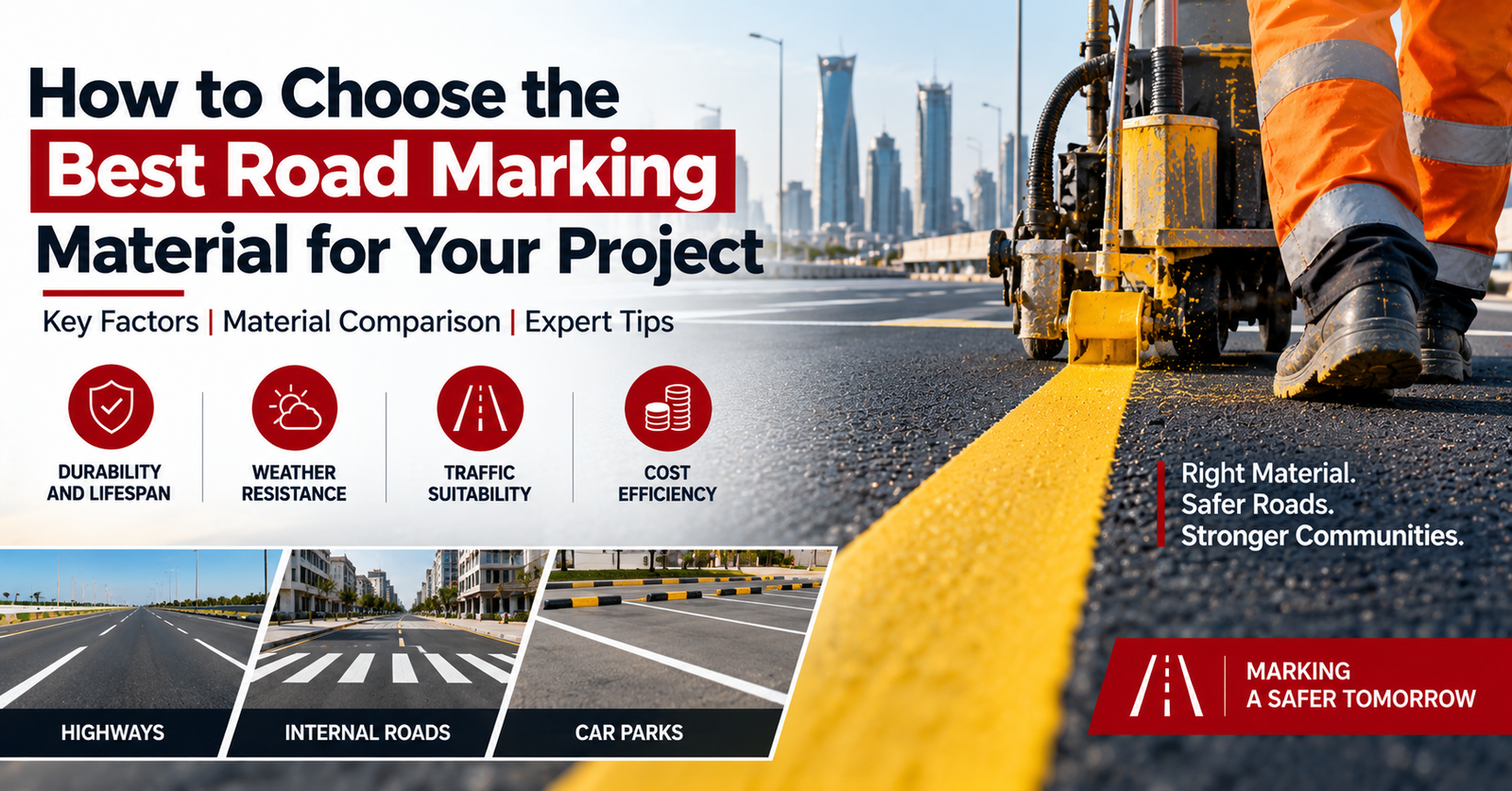
 Road Marking in saudi arabia and qatar
A parking layout gets painted in March. By November the lines have faded to grey, the arrows are half gone, and the facility manager is asking for a repaint that was never in the budget. The material was not “bad” — it was the wrong material for that surface, that traffic and that heat.
This happens across road marking projects in Qatar and Saudi Arabia more often than it should, because material selection is usually left to whoever quotes lowest. This guide explains the three main options, where each one works, and what to check before you commit.
The Three Materials You Will Actually Be Offered
Most road marking services in Qatar and Saudi Arabia work with one of three systems:
Thermoplastic — a solid compound heated and applied hot, usually 2–3 mm thick. It bonds to asphalt, holds glass beads well for night visibility, and handles heavy traffic. This is the standard for highways, main roads and busy internal roads.
Cold paint (solvent or water-based) — applied thin with a spray or roller. Fast, low cost and easy to touch up. Suits low-traffic car parks, warehouse floors, temporary layouts and anywhere the lines will be redone regularly.
MMA (methyl methacrylate) cold plastic — a two-component resin that cures chemically rather than by drying. Very durable, works on concrete as well as asphalt, and tolerates high surface temperatures. Used for high-wear spots such as junctions, roundabouts and anti-skid areas.
Which Material Fits Which Situation?
The right answer depends on four things: traffic, surface, climate and how long you need the marking to last.
| Situation | Usual choice | Why |
| Highway or arterial road | Thermoplastic | Thickness and bead retention under constant traffic |
| Multi-storey or open car park, asphalt | Thermoplastic or cold paint | Depends on turnover and repaint budget |
| Concrete car park or warehouse floor | MMA or epoxy-type paint | Thermoplastic bonds poorly to smooth concrete |
| Junctions, speed humps, cycle lanes | MMA | Abrasion and skid resistance |
| Temporary diversion or event layout | Cold paint | Cheap, removable |
If your surface is concrete, do not accept a thermoplastic quote without asking about primer and adhesion testing. It is one of the most common causes of early failure.
Why Heat Changes the Decision in the Gulf
Summer surface temperatures on asphalt in Doha or Riyadh can exceed what many marking materials are designed for. Thin cold paint can soften and pick up tyre marks. Poorly formulated thermoplastic can track under slow, turning traffic.
Ask any road marking company in Saudi Arabia or Qatar two direct questions: has this material been used on comparable sites through a full summer here, and what softening point does the manufacturer state? A contractor who works in the region year-round will answer both without hesitation.
What to Check Before You Sign Off
- Surface preparation — cleaning, and priming where required, is where most failures start. It should be a line item, not an assumption.
- Glass beads — for any road used at night, confirm beads are applied and at what rate. Without them, lines disappear in headlights.
- Thickness or coverage rate — thermoplastic should be stated in mm; paint in m² per litre. Vague quotes hide thin applications.
- Layout drawing — insist on a marked-up plan before work starts, especially for car parks.
- Cure and reopening time — thermoplastic reopens in minutes, MMA in under an hour, paint may need longer. Plan the closure around it.
Common Mistakes
- Choosing cold paint for a busy car park because it is cheapest, then repainting every year.
- Applying thermoplastic on unsealed concrete.
- Skipping beads on internal roads that are used after dark.
- Marking a new asphalt surface before it has cured, causing bleed and poor bond.
Where Manycon Fits
Manycon delivers thermoplastic, cold paint and specialist marking systems across Qatar and Saudi Arabia, alongside epoxy flooring and surface coatings. For clients running sites in both countries, that means one contractor specifying to local conditions on either side of the border.
Key Takeaways
- Match material to traffic, surface and climate — not price alone.
- Thermoplastic for roads, MMA for high-wear and concrete, cold paint for low-traffic and temporary.
- Preparation, beads and application thickness decide how long the marking lasts.
Frequently Asked Questions
How long does thermoplastic road marking last?
On a properly prepared asphalt road, typically several years depending on traffic. Cold paint on the same road may need refreshing within a year.
Can thermoplastic be used on concrete?
Only with a compatible primer and adhesion testing. MMA is usually the safer choice on concrete.
What are glass beads for?
They sit in the surface of the marking and reflect headlight beams back to the driver, making lines visible at night.
Is cold paint suitable for outdoor car parks in Qatar?
For low-traffic areas with regular repaint budgets, yes. For busy or high-turnover car parks, thermoplastic or MMA lasts longer.
What is MMA road marking?
A two-part acrylic resin that cures chemically. It is highly durable, works on concrete and asphalt, and is used where abrasion resistance matters.
How soon can traffic use the road after marking?
Thermoplastic: minutes. MMA: under an hour typically. Cold paint: depends on product and temperature — check the datasheet.
